
Although humans cannot hop into a time machine and travel back in time, we do know that clocks on airplanes and satellites can run at a different rate than clocks on Earth. However, after the airplane has landed, the difference disappears from our everyday experience. Time is both a reality and, in some ways, an illusion. Physical laws work within the limited, observable universe, but when we go beyond that, things may become far more complicated.
Space telescopes allow us to look back in time. These instruments enable us to observe galaxies that are unimaginably far away. Because light takes time to travel through space, when we look at distant stars and galaxies, we see them as they appeared millions or even billions of years ago. Many of these stars may no longer exist. The actual events are long gone. What we observe is only the radiation—the light—that continues to travel through space.
When it comes to “time travel,” most people imagine traveling faster than one second per second. That kind of time travel seems more like science fiction than reality. Can we return to the past and change events that have already happened? Some scientific theories suggest it may be possible. I disagree.
I believe time is much more complicated than simply moving fast enough to reach the past. Even more impossible, in my opinion, is the idea of changing events that have already taken place. Events cannot occur a second time simply because someone travels back in time.
Once an event has happened, only the radiation it produced continues its journey through space. The event itself no longer exists.
The famous scientist Albert Einstein developed a theory explaining how time works. He called it the Theory of Relativity. According to this theory, time and space are linked together. Einstein also stated that our universe has a speed limit: nothing can travel faster than the speed of light, approximately 186,000 miles (300,000 kilometers) per second.
However, I believe that quantum physics raises questions that Relativity alone cannot fully answer. Quantum entanglement demonstrates instantaneous correlations between linked particles across vast distances. In my view, this suggests that Einstein’s equations describe only the observable universe and may not represent the complete picture of reality.
Scientists have also demonstrated that time can pass at different rates depending on gravitational circumstances.
During the Hafele–Keating experiment in 1971 four cesium atomic clocks flew aboard commercial airliners around the world eastward and westward, then compared them to stationary clocks at the U.S. Naval Observatory. The results showed the moving clocks lost about 59 nanoseconds eastward and gained about 273 nanoseconds westward, matching relativistic predictions within the experiment’s precision. The clock on the airplane had recorded slightly less elapsed time than the clock that remained on Earth.
The same phenomenon is observed with satellites, which require constant time corrections. In my opinion, these corrections are necessary because of the relationship between the satellite and the observer, not because the satellite has permanently entered a different timeline or time frame.
Clocks are mechanical or electronic devices. Their construction does not fundamentally change because of where they are located. However It is undeniable that observers can measure differences in behavior based on the force of gravity.
Albert Einstein explained this effect through gravitational time dilation. According to his theory, gravity slows the passage of time. The stronger the gravitational field, the slower a clock ticks compared with one located where gravity is weaker. This effect becomes significant near massive objects such as planets and stars, which curve the fabric of spacetime.
The Hafele-Keating experiment does not contradict gravitational time dilation; instead, it perfectly proves that time runs faster at higher altitudes.
The misconception that the experiment showed time slowing down uniformly comes from overlooking the fact that two competing relativistic forces were measured at the same time: gravity (General Relativity) and velocity (Special Relativity)
And what regarding the universe as a whole?
Scientists believe that a single, overarching clock for the entire universe does not exist. Einstein’s General Relativity states that space and time are fused into a dynamic, four- dimensional fabric called spacetime. This “unwillingly” supports the idea of a creator not bound to space and time.
All of it remains weird. Science can be based faulty and incomplete calculations misformed by the hologram in which we live. Since it becomes more and more clear that nothing is what it looks like we can seriously doubt whether formulas are sustainable in a broader perspective of reality.
To end this story, look at images from the past pointing to people that supposedly show objects from the future.

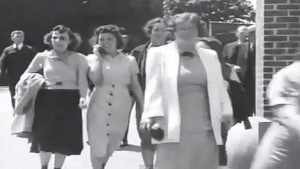
Old photographs contain people apparently using cell phones during the Roaring Twenties.
And what to think about the modern-looking flat-screen display appearing in a busy street decades before such technology existed.
Glitches in time showing devices outside their proper place in history.